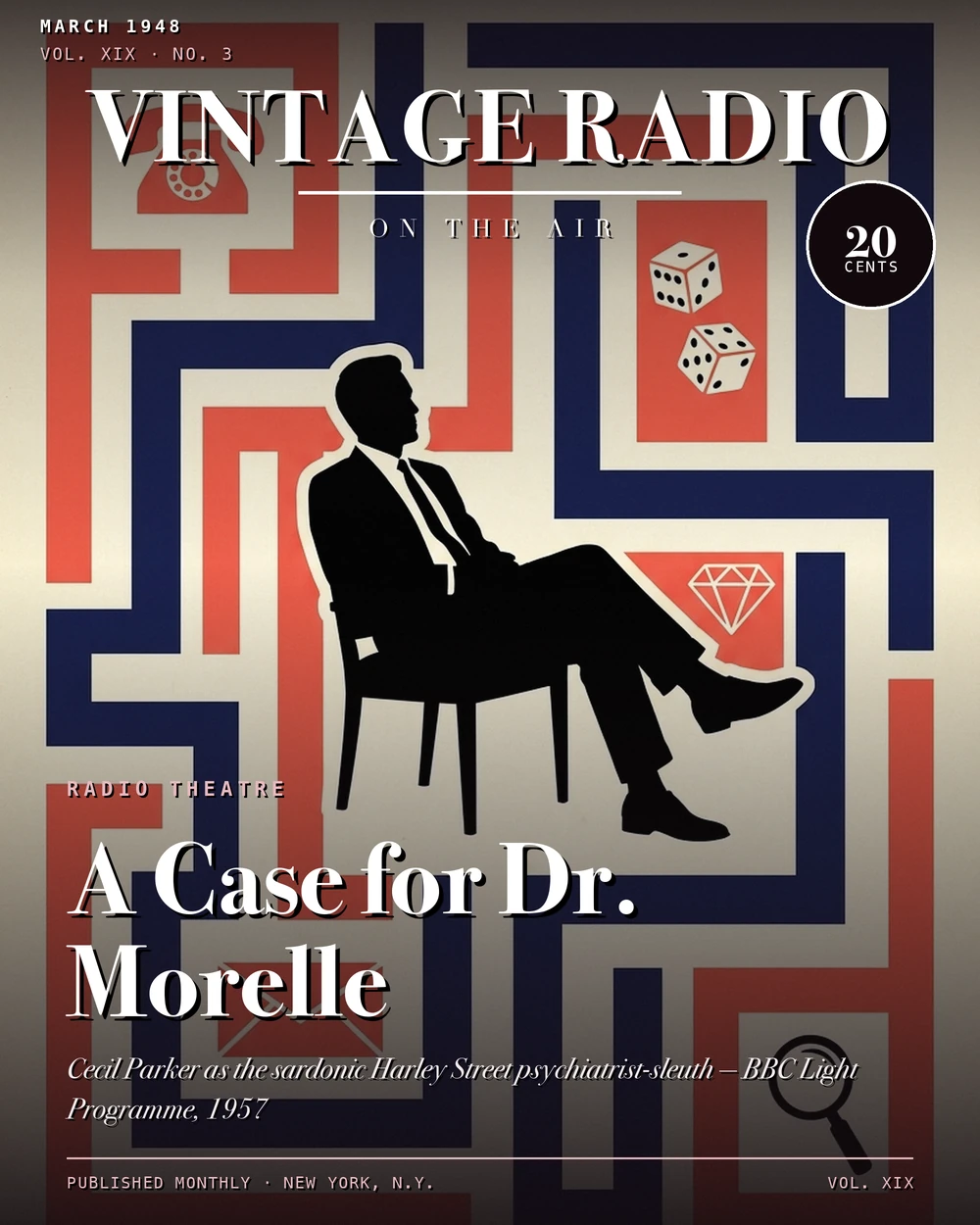
A Case for Dr. Morelle
The Man You Love to Hate
Ernest Dudley created Dr. Morelle during World War Two air raids — which says something about the character right away. Dudley, born Vivian Ernest Coltman-Allen in 1908 and active as an actor, novelist, dramatist, journalist, and screenwriter well into his later years, wanted to build a detective unlike the ones already crowding the airwaves. His model was partly Erich von Stroheim, the autocratic film director notorious for his imperious manner on set. Dudley even coined a nickname for his creation: "the man you love to hate." There was also a practical motive. Dudley wanted a strong comic role for his wife, actress Jane Grahame, and the long-suffering secretary Miss Frayle gave him exactly that.
The character first appeared on the BBC's anthology programme Monday Night at Eight in 1942, in segments called "Meet Dr. Morelle." Dennis Arundell played the doctor in those early outings, with Jane Grahame as Miss Frayle. By the 1947–1948 season, Heron Carvic had stepped into the lead. Then, in the spring of 1957, the BBC brought the character back for a dedicated weekly series — thirteen episodes, broadcast on the BBC Light Programme from April 23 to July 16 — with Cecil Parker taking the role and Sheila Sim as Miss Frayle.
Who Dr. Morelle Was
Dr. Morelle operates out of Harley Street, London's famous address for specialist physicians, and he works as a criminal psychologist — or, more precisely, a psychiatrist-sleuth. He doesn't prowl crime scenes looking for footprints or fiber samples. His method is to interview suspects, fit their behavior to psychological profiles, and work out the shape of a killer's mind from the inside. The cases he takes on are the ones too tangled to resolve through ordinary means — he is, in the show's framing, a last resort, and a distinctly unpleasant one.
The unpleasantness is part of the design. Most episodes open with Miss Frayle absorbing another round of Dr. Morelle's sarcasm. She is patient to a degree that strains credibility, and that dynamic — her endurance, his contempt — runs beneath every case like a low current. By the final scene, the psychological machinery clicks into place and the killer is identified, but the resolution comes from Morelle's cool, analytical dissection of motive and personality rather than from any dramatic physical confrontation or lucky discovery.
Cecil Parker and Sheila Sim
Cecil Parker, born Cecil Schwabe on September 3, 1897, had spent decades making a specialty of supercilious and authoritative men. His voice — described as distinctively husky — was one of the most recognizable in British character acting, and he had made 91 films between 1928 and 1969. He also had a claim to theatrical history: he originated the role of Charles Condomine in Noël Coward's Blithe Spirit at its 1941 West End opening, a production that ran for nearly 2,000 performances. For Dr. Morelle, the combination of Parker's vocal texture and his well-practiced comic hauteur fit the character's requirements almost exactly. The premiere episode, "Alarm Call," introduces his interpretation of the role and shows how Miss Frayle comes to be working for him in the first place.
Sheila Sim, born June 5, 1922, was not a radio regular but had a substantial film career behind her, including Powell and Pressburger's A Canterbury Tale in 1944. She is perhaps best known for co-starring with her husband Richard Attenborough in the original 1952 West End cast of Agatha Christie's The Mousetrap. She was mainly active through the 1940s and 1950s, which made the 1957 series a natural fit for her professional moment.
How the Series Was Put Together
Producer Leslie Bridgmont shaped the 1957 run, and each episode ran approximately 30 minutes. The series used what was then a common structural device on both radio and television: a teaser — a compelling excerpt from the script — played before the theme music and title announcement, pulling listeners in before the formal episode began. Thirteen episodes aired in sequence from late April through mid-July, giving the BBC Light Programme a compact, self-contained mystery run through the early summer months.
The episode titles across the run give a reasonable sense of the range: "Confession of Guilt," "The Blackmailer," "Poisoned Air," "The Sleepwalker," "Voice in the Night," "Act Of Violence," "The Black Ruby," "The Wedding Dress," "The Will," "The Gambler," and "Mister XY," alongside "Alarm Call" at the start. Several titles nod directly toward psychology and concealment — confession, sleepwalking, blackmail — which fits a show built around the idea that crime is primarily a mental event.
The Character Beyond the Radio Series
Dr. Morelle had a longer life outside these thirteen episodes than most radio detectives manage. Ernest Dudley wrote approximately fifteen novels and several volumes of short stories featuring the character, and he co-wrote a stage play, Dr. Morelle, with Arthur Watkyn. In 1949, Hammer Films produced Doctor Morelle: The Case of the Missing Heiress, with Valentine Dyall in the title role, drawing on both the radio series and the stage version. The character also reached international audiences, with radio versions produced in Australia and Germany.
In 1999, the BBC returned to the character again — this time in a documentary, A Case for Dr Morelle, in which cultural historian Professor Jeffrey Richards examined what Dudley had built and why the "Harley Street detective" had stayed in the cultural memory as long as he had. Seven episodes from the 1957 series were later collected by BBC Audio as Dr Morelle: Collected Cases, part of the Classic Radio Crime series.
Why It Still Holds Up
The appeal of A Case for Dr. Morelle was never really about plot mechanics. The mysteries are tidy enough, but what kept listeners tuned in was the dynamic between a brilliantly unpleasant man and the person who chooses, for reasons the show leaves largely unexplained, to keep working for him. Dudley built that tension into the character from the start, taking the classic formula of detective and assistant and inverting the warmth entirely. There is no affection between Morelle and Miss Frayle — only her tolerance and his condescension, episode after episode. The crimes, in a sense, are almost incidental.
Parker understood that, and his performance reflected it: his vocal authority carried Morelle's disdain without tipping into pure grotesque. The 1957 series was a relatively short run, but it landed on well-prepared ground — a character with fifteen years of prior radio history, a body of prose fiction behind him, a Hammer film to his name, and an international audience who already knew what to expect when they heard the name.